Design & Color
The Paniolo Interior: Ranch-Influenced Design on Maui and the Big Island
The first time I drove up to Kula on a cool May morning, the air changed around the 2,000-foot mark — eucalyptus, red dirt, the smell of something damp and almost alpine. I had just come from a client meeting in Kahala, where the light is white and generous and the ocean sits flat at the horizon like a pane of glass. Upcountry Maui is a completely different conversation. The road to Makawao narrows and winds, pastures roll toward Haleakalā's dark silhouette, and the color of everything — the soil, the dried grass, the old wooden storefronts — tells you immediately that this is not the Hawaii most visitors think they know.
The paniolo interior is the design language that grows out of this place. And it is, in my experience, one of the most underappreciated aesthetic traditions in all of the islands.
What Makes a Room Feel Paniolo
Paniolo is the Hawaiian word for cowboy, and the ranching culture it names goes back to the early 19th century — when Spanish vaqueros from California came to teach Hawaiians how to work cattle. What they left behind was a material culture: leather, heavy cloth, hand-worked wood, the pragmatism of a working ranch. Over two centuries, that sensibility shaped the character of Upcountry homes in ways that are still visible today.
This is not a Western theme. I want to be direct about that. A genuine paniolo interior is quieter and more sophisticated than anything involving horseshoe hardware or matching cowhide pillows. It is the aesthetic of someone who works outdoors and comes home wanting something solid and warm. Materials that age visibly and beautifully. Things that look better at ten years than they did new.
Walk through the older homes in Makawao and you understand it instinctively: plank ceilings, wraparound lanai, furniture that was built to last rather than to impress. The design conversation there is different from what's happening in Kaka'ako right now — less self-conscious, more rooted in daily life.
The Palette: Pulled from Dirt, Grass, and Sky
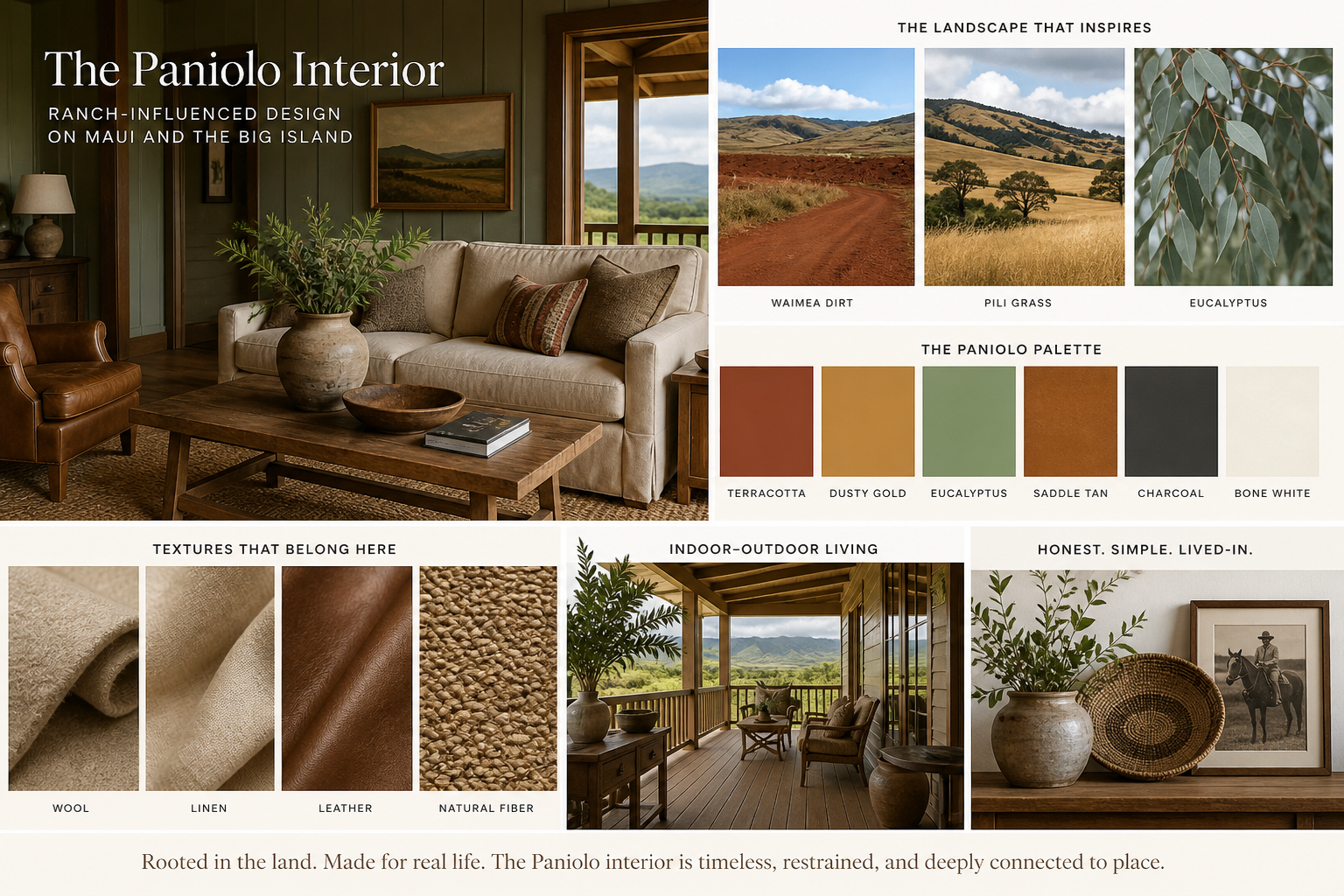
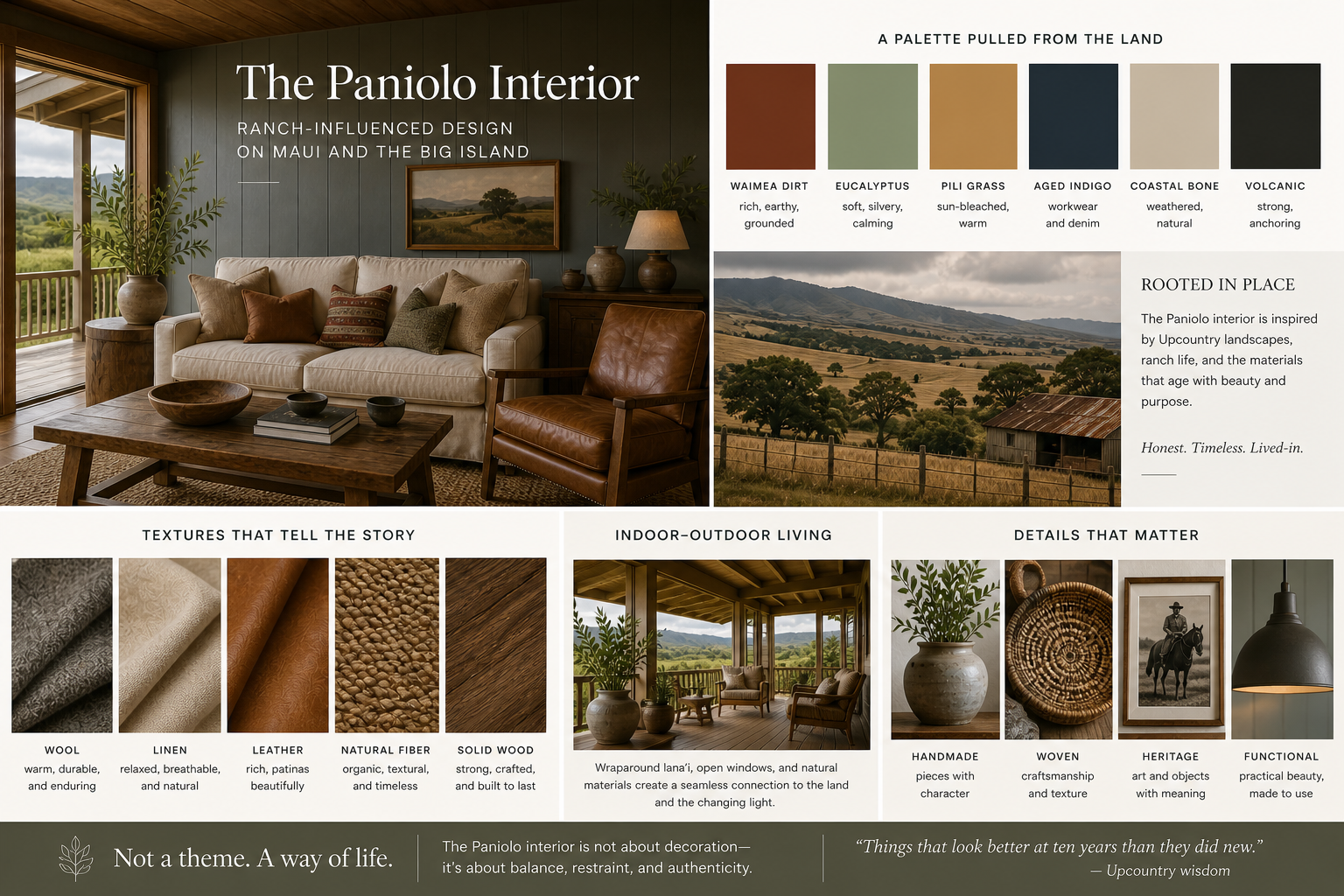
If you've driven through Waimea on the Big Island on a late afternoon, you already know the colors. Waimea dirt is a deep, almost burnt terracotta — red enough to stop you, brown enough to stay elegant. The pili grass that lines the Kohala hillsides fades to a warm, dusty gold by midsummer. The eucalyptus that defines Upcountry Maui is a silver-green so specific that no standard paint chip quite captures it — you have to name it yourself.
Add to this: saddle leather tan, aged indigo from the denim and workwear that ranching culture runs on, the bone white of dried coastal wood and old fence posts, and the deep charcoal that Haleakalā's volcanic slopes contribute on a clear morning. This palette is warm, layered, and deeply anchored. It does not need the ocean. It is not trying to bring the beach inside.
What genuinely excites me about this palette is how well it performs in contemporary interiors that have nothing to do with the ranch context. A Kailua home done in pale whites and sea glass needs the generous, steady windward light to hold together. A paniolo palette works in a Makawao farmhouse, obviously, but it also works in a Honolulu townhouse with small windows, or a Hilo craftsman where the rain keeps things dim for weeks at a time. The depth carries.
Textiles That Belong Here
The fabrics that belong in a paniolo interior are not subtle about their materiality. You want to feel them when you walk past — the weight of a good wool, the slight roughness of a raw linen, the warmth of leather or suede against your palm. These are not fabrics chosen for delicacy.
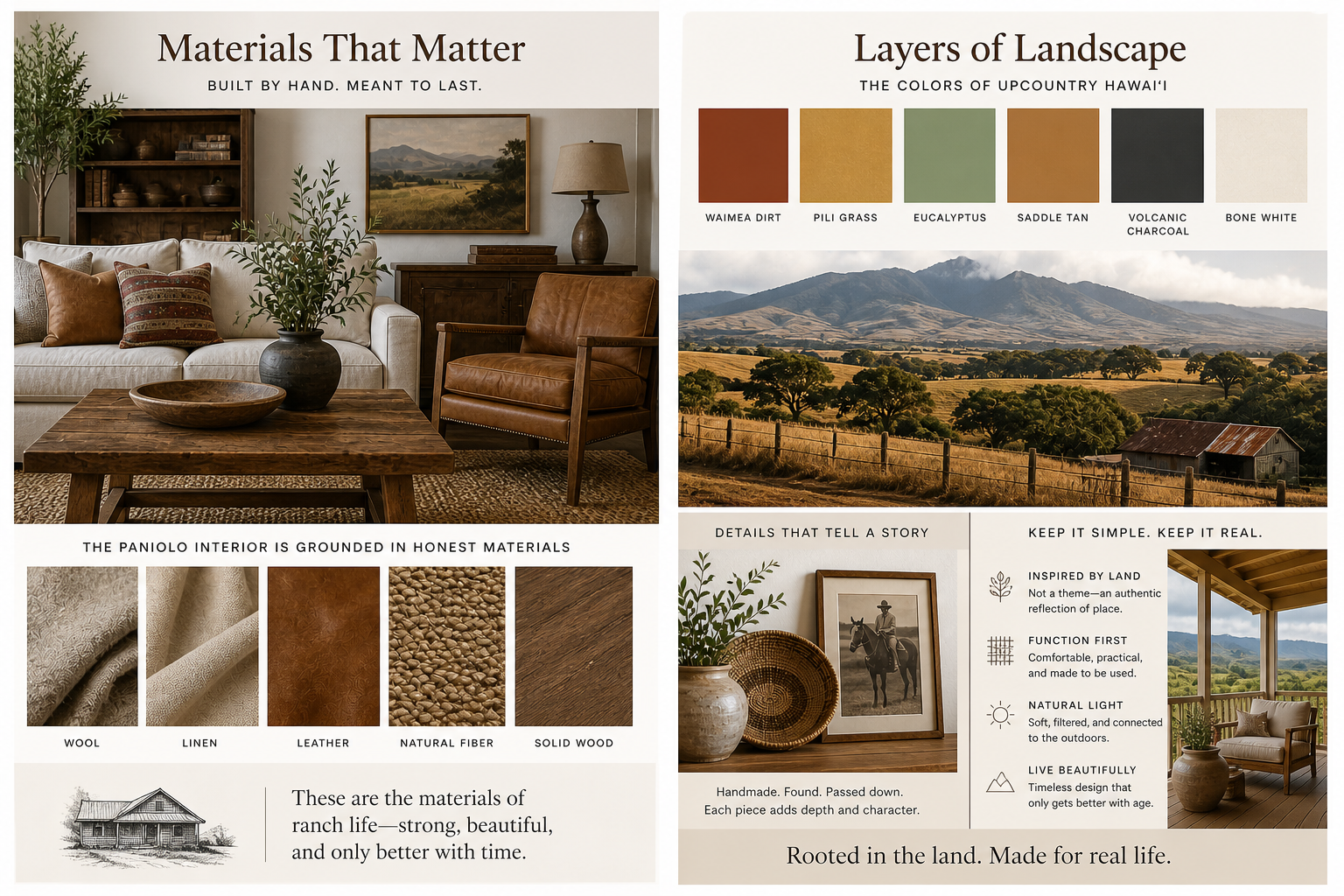
Wool is the starting point. Not the kind of worsted wool that belongs in a British drawing room — something more relaxed. A soft Highland-weight or a wool-linen blend that drapes without stiffness. On the Big Island, where Waimea evenings get genuinely cool, wool upholstery makes practical sense in a way it rarely does elsewhere in Hawaii. On Maui, a wool throw over a linen sofa is not decorative staging — it gets used.
Leather is the second conversation. Not pristine, not matched. I lean toward hides that show natural variation in color across the surface — the kind that will develop a patina rather than just wear. A settee in Waimea dirt brown. A pair of chairs in saddle tan that will darken over the years. This is furniture that tells a story rather than freezing at the moment of purchase.
The handwoven layer completes it: grass cloth on walls, jute or sisal underfoot, chunky-weave linen at the windows. These connect the interior to the landscape without literalizing it — you don't need palm fronds in the pattern to make the reference.
Waimea and the Big Island: The Quieter Counterpart
Upcountry Maui gets most of the attention in design conversations about the paniolo aesthetic. But Waimea — the ranching town at the foot of the Kohala mountains on the Big Island — is equally rich, and in some ways even more interesting.
The light in Waimea is different from Maui's. Cooler, with a quality that is almost continental. The Kohala mountains hold cloud in a way that Haleakalā does not, and the town sits at an elevation where you genuinely need a jacket in the evenings. Parker Ranch has defined the visual identity of Waimea for over two centuries — and its influence on local interiors is real. Not as nostalgia, but as practical history. Families have been ranching this land for generations. Their homes reflect that continuity: materials chosen for longevity, colors that work with the light rather than against it.
What Waimea teaches about interiors is restraint — but not the kind that comes from minimalism as a stylistic choice. This is the restraint of people who know exactly what they need and have no interest in excess. An interior designed in this spirit is confident without being showy. The bones are good because the furniture is solid. Nothing asks to be rearranged.
Bringing It Home Without Going Costume
The risk with any strong regional aesthetic is costume — lean too hard on the references and you end up with a theme rather than a room. A paniolo interior done badly looks like a ranch supply store. Done well, it looks like a home that knows itself.
The way to avoid the costume is to mix. Pair the saddle leather chair with something more contemporary — a clean-lined linen sofa, a rug whose Waimea Canyon red comes from a modern geometric pattern rather than a Navajo-adjacent design. Let the paniolo elements be the warmth and the weight of the room, not its entire narrative.
I'd also push back against the impulse to accessorize your way to this aesthetic. The paniolo interior is not built from spurs hung on walls. It is built from materials — the right upholstery, the right rug, the right curtain weight — and those materials create the feeling without needing illustration.
The Practical Starting Points
Upholstery: Begin with a wool or wool-blend solid in Waimea dirt terracotta, Haleakalā charcoal, or dried pili grass gold. Add one leather piece — a chair, an ottoman — in a contrasting but harmonious tone. These two materials together do more work than any number of accent pillows.
Rugs: Natural fiber first. Sisal, jute, or seagrass in a flat or low weave — something that grounds the space without competing for attention. If the room is large, layer a smaller wool or leather-trimmed piece over it. The layering is part of the visual logic.
Window treatments: Linen or linen-cotton blend, unlined, in a natural or warm white. Let them move. The paniolo interior does not need blackout; it needs air and the particular quality of Upcountry afternoon light coming through something that breathes.
Walls: This is where eucalyptus silver-green or Upcountry soil terracotta can appear — or a sisal wallcovering that adds texture without a pattern commitment. Keep it muted. Let the texture do the work rather than the color.
One honest element: A piece of furniture or a single object that shows its material without apology. A live-edge table, a hand-thrown ceramic in Waimea Canyon red, a basket woven from natural fiber. Not as a statement. As evidence that someone chose it for real reasons.
The paniolo interior is, at its core, an interior about commitment — to materials, to place, to the idea that a room should feel earned rather than assembled. That is not a bad philosophy for any home in Hawaii. It is also, I would argue, not a bad philosophy for design anywhere.
Stay in the Loop
New arrivals, seasonal
stories & studio notes.
Join the Hale circle. Be the first to know about new fabric arrivals, limited accessory drops, and studio events.
No spam. Unsubscribe at any time.